

The Slingshot and the Algorithm
Jewish Moral Imagination and the Uncomfortable Future

Malcolm Gladwell, in David and Goliath, makes a counterintuitive argument: David didn’t win through divine favor or raw courage. He won because he brought better technology to the fight. The slingshot, in the hands of a practiced slinger, was a precision weapon, faster and more accurate than anything a heavily armored giant could answer. David’s genius was not merely bravery. It was tactical innovation.
This reframing should feel familiar to anyone who has spent time with Jewish history. From antiquity through the modern era, Jewish survival has rarely been a matter of brute force. It has been a matter of leverage, intellectual, linguistic, and technological. Jewish traders commanded markets not through armies but through polyglot fluency and networked trust across hostile borders. Medieval Jewish cartographers and astronomers produced the navigational tools, the portolan charts and the refined astrolabe, that made European exploration and trade development possible. It also made colonization and the Atlantic slave trade possible. Jewish artisans monopolized metalwork and textile trades in economies that excluded them from land ownership. When the doors of the academy finally opened, Jews flooded into medicine and physics with a velocity that suggested centuries of pent-up intellectual pressure finding its release as well as centuries of practical application. From Maimonides to Einstein, the pattern holds: find the lever, apply it precisely, and survive.
But there is another side to this history, and it is darker. The same bureaucratic technologies that made the modern state a functioning juggernaut, the census records, identity papers, and punch-card sorting systems, were turned, in the twentieth century, into instruments of annihilation. IBM’s tabulating machines did not build the Holocaust, but they made it administratively efficient. The Jews of Europe did not fail to understand technology. They were destroyed, in part, by it, by the technology of others, wielded without moral restraint.
This double inheritance, technology as lifeline, technology as weapon, produces a particular kind of moral imagination. Not technophobia, and not techno-utopianism either, but something more demanding: a refusal to separate the question of what can be built from the question of what should be built. That refusal runs through Jewish intellectual life from the Talmud to Spinoza, and it runs, I would argue, through the best of Jewish science fiction and comics as well.
The tradition is long and distinguished. Siegel and Shuster gave us Superman, an alien immigrant whose powers are both gift and burden, and whose greatest moral challenge is knowing when not to use them. Stan Lee and Jack Kirby populated Marvel with superheroes defined less by their abilities than by their ambivalence about those abilities. Isaac Asimov built an entire career on a single animating question: if we create minds, what do we owe them, and what do they owe us? Harlan Ellison was angrier, more jagged, but asked the same thing from the other direction: what happens when the machines stop serving us and start defining us?
That tradition continues in the graphic novel form, and two recent additions to the Jewish Comics Library of Seattle exemplify it with particular force.
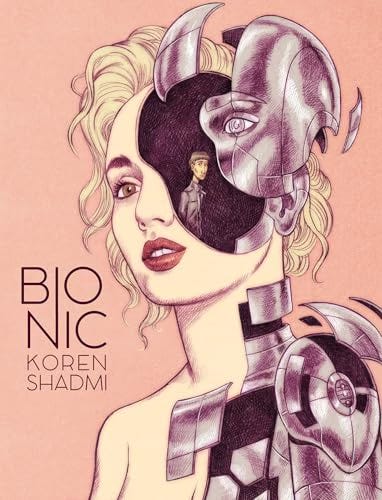
Koren Shadmi’s Bionic opens with a catastrophe and a rescue. A girl is struck by a car and saved through extensive technological reconstruction by her father’s company. She became the first fully bionic human being, a medical miracle and a media sensation. The company, struggling before the accident, is revived by the publicity. The question Shadmi refuses to let go of is the one the daughter cannot stop asking: did my father save me, or did he save his company? Did he love me, or did he love the opportunity I represented? Did he set the whole thing up from the start?
The technology here is not the villain. It is the instrument through which an already-existing moral failure, a father’s compromised love, a company’s conflation of human value with market value, becomes visible and permanent. The daughter’s enhancements are real; so is her trauma. The boy who falls in love with her accepts her bionic body without hesitation, which is presented as a kind of grace. But even he cannot fully reach her, because the wound is not in her circuitry, it is in her understanding of what she is worth to the people who were supposed to love her unconditionally.
Shadmi is asking, in visual form, the question that haunts every contemporary debate about medical technology, enhancement, and the commodification of the body: when we intervene to save a life, whose interests are we actually serving?
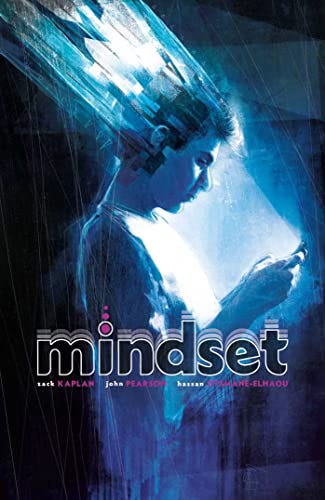
Zack Kaplan’s Mindset operates in more explicitly Spinozan territory. The premise, an app capable of inserting thoughts directly into users’ minds, functioning like an algorithm that bypasses the pretense of choice, is a satirical extrapolation of social media’s actual architecture. We already live in an environment engineered to colonize our attention; Kaplan simply removes the intermediary steps.
When a murder occurs, the question of responsibility becomes genuinely vertiginous. If a thought was planted, is the thinker responsible for acting on it? If the app was designed to produce certain behaviors, is the designer the true author of those behaviors? And who was controlling whom in the development process? Spinoza would have recognized the problem immediately. His entire philosophical project was a sustained argument that what we call free will is largely a story we tell ourselves after the fact, that true causes run deeper than our awareness of them. The Talmudic legal concept of grama, indirect causation, poses the same challenge from a different angle: if I set a fire and the wind carries it to your field, am I responsible for your loss? The rabbis spent centuries on this question. Kaplan dramatizes it in a hundred and fifty pages.
Neither answer is comfortable. Both texts resist it.
It is worth noting, briefly, that neither Shadmi nor Kaplan foregrounds Jewish identity in these narratives, even as they themselves openly identify as Jewish. Their protagonists could be read as Jewish, but nothing in the exposition requires it. What is Jewish about these books — if that framing is even finally the right one — is structural rather than thematic. It is a habit of moral attention. A refusal of easy resolution. An insistence on asking who bears the cost of someone else’s ingenuity.
This is why these books belong in the JCLS, alongside the more explicitly Jewish-themed titles in the collection. They represent a strand of consciousness that the tradition has carried for a long time: the awareness that every tool is also a potential weapon, that every innovation arrives trailing unintended consequences, that the gap between what we can do and what we should do is not a technical problem but a moral one, and that moral problems do not come with instruction manuals.
David brought a slingshot to a sword fight and won. We celebrate that. What the story doesn’t linger on is Goliath’s perspective, the giant who never saw it coming, who had no framework for understanding what had just happened to him, who was simply standing there when his world changed.
We are living, right now, inside a version of that gap. Adaptive technology promises to extend our capacities, repair our bodies, and amplify our minds. It may do all of those things. It will also, if history is any guide, be turned against someone. The question is not whether to engage with it, that choice is largely no longer ours to make. The question is whether we remain morally awake inside it.
Shadmi and Kaplan are not prophets. They are comics artists doing what the tradition has always done: holding up a mirror, asking the inconvenient question, and refusing to look away before we’ve really seen what’s there.
Goliath didn’t see it coming. We have no such excuse.

We are one of the many non-profits who participate in the annual fundraising efforts of WA Give Big. Another way to support our work is to click the Give Big image and make a donation.
Our next Pop Up Library will be on Friday, May 8, 11:00 AM-3:00 PM at the Couth Buzzard Bookstore, 8310 Greenwood Ave N, Seattle. It is also a cafe that serves coffee, delicious baked things, lunch, beer and wine. So when you come to browse the shelves of JCLS or engage in a conversation about the collection, you can sip and nibble away.
We are proud to be funded by 4Culture, newsletter subscribers, and our patrons.